
How to Stop Comparing Yourself to Others

You see the announcement. A promotion, a new house, a relationship that looks perfect in photos. Something in you contracts.
The feeling has a particular texture. Part envy, part deflation, part a sudden sense of being behind. The comparison is already done before you’ve had time to object.


Why the Brain Keeps Comparing
Social comparison is built into how cognition works. In 1954, psychologist Leon Festinger proposed his social comparison theory: people evaluate their abilities, opinions, and worth by measuring them against others. The drive isn’t vanity. When there’s no objective standard available, other people become the reference point.
The system evolved for small groups. Village-sized numbers, maybe 50 to 150 people. Social media has expanded that comparison pool to millions, all of them showing curated versions of their best weeks. The brain runs comparison software designed for one context, now operating in a completely different one.
And social media isn’t even the only trigger. Colleagues who got promoted faster. Friends who seem to have their finances together. Siblings on different timelines. The comparison pool is everywhere, and the brain treats all of it as relevant information.
What Comparison Does to Self-Worth
Upward comparison, measuring yourself against someone you perceive as doing better, reliably deflates self-evaluation. Research published in Scientific Reports found that social comparison combined with maladaptive emotion regulation is linked to higher levels of anxiety and depression, and creates a self-reinforcing cycle with increased social media use.
A systematic review on PubMed examining social comparison across multiple studies found consistent associations between comparison habits and both depression and lower life satisfaction. The frequency matters as much as the content. The more automatic the habit, the heavier the cumulative effect.
There’s also a distortion built into every comparison. You’re measuring your full internal experience, the false starts, the doubt, the 3am low points, against someone else’s external output. That’s a structurally unfair comparison. And the gap it creates feels real even when the comparison itself is skewed.
The Loop It Creates
Comparison tends to feed back into behavior in ways that make the original problem worse.
When you feel behind, the typical response is either anxious overactivity or disengagement. Neither tends to produce what you actually want. The belief that you’re too late, too slow, or not enough becomes justification for avoiding the very things that could change that. The overlap between habitual comparison and self-sabotage is significant: one fuels the other in a loop that’s easy to miss while it’s running.
Negative self-talk reliably spikes after comparison triggers. The voice that says “you’ll never get there” or “why bother” doesn’t emerge from nowhere. It feeds on specific moments where someone else’s progress was processed as evidence against you.
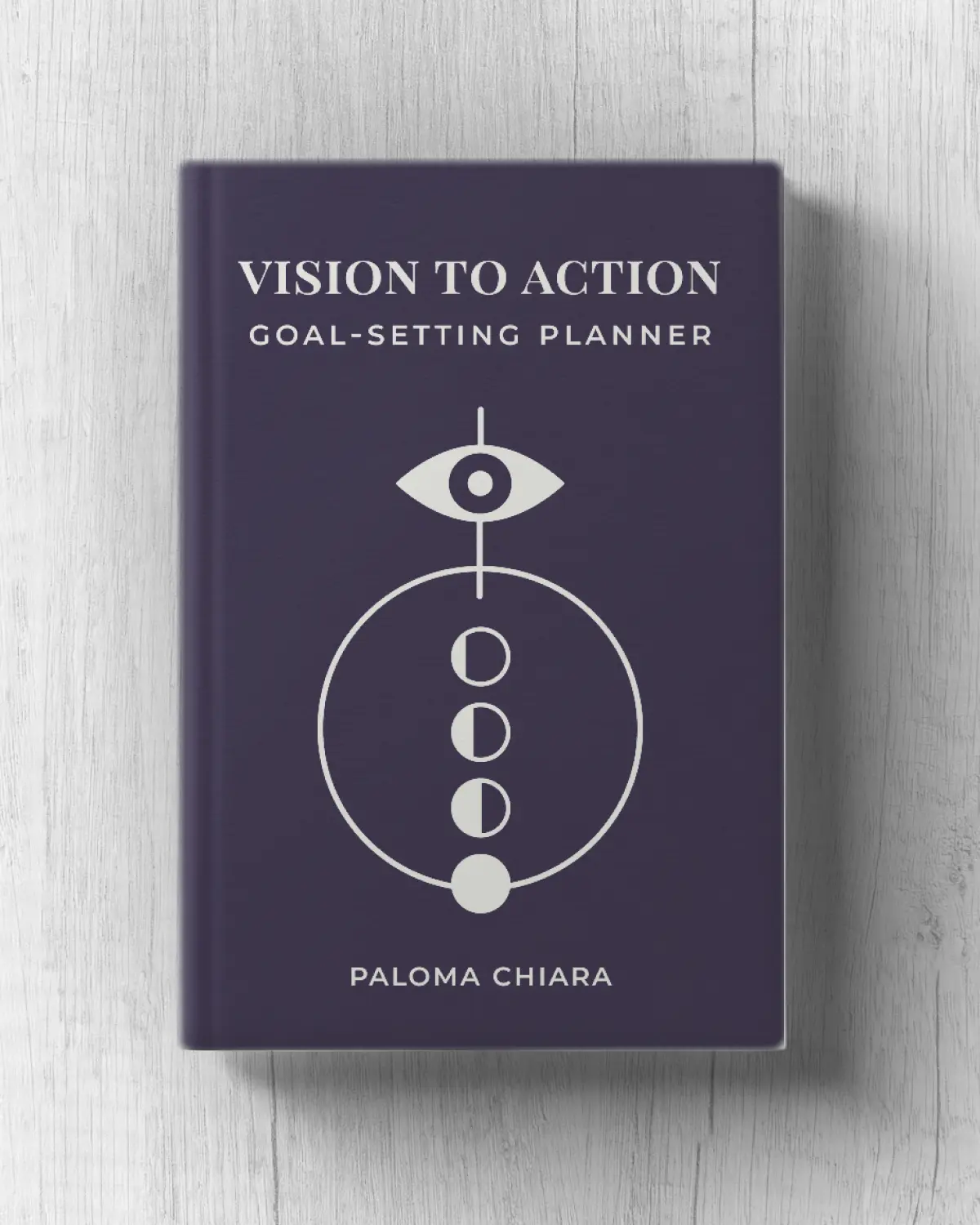
Check out the Free · Vision to Action Planner
More infoWhy Deciding to Stop Doesn’t Work
The decision to stop comparing doesn’t stick because the comparison happens below the level of decision. It’s automatic, running before you’ve consciously engaged.
The first thing people try is suppression: catch the thought, redirect it, dismiss it. This works briefly and tends to strengthen the thought over time. Thought suppression research has demonstrated this pattern consistently. Trying to not think about something gives it more mental attention, which makes it more available, not less.
Unfollowing certain accounts can reduce triggers but doesn’t address the underlying reflex. The trigger surface shrinks; the habit remains. You can remove every visible prompt and still compare yourself to colleagues, old friends, or anyone you perceive as occupying a position you want.
What Actually Shifts It
Use your own history as the baseline. Are you more capable, clearer, or further along than you were 2 years ago? That question is answerable. How you stack up against someone whose circumstances, background, and path you don’t fully know isn’t.
Treat the comparison as a signal. When someone else’s success bothers you, something worth examining sits underneath the discomfort. Usually a signal about what you want, or where you feel behind on your own terms. That’s worth paying attention to. Spiralling into self-doubt is not.
Build an internal reference point for self-worth. When self-esteem depends entirely on relative standing, comparison hits harder because there’s no stable ground beneath it. Developing a clearer sense of your own values and direction makes external benchmarks less destabilizing.
Audit your inputs deliberately. Beyond unfollowing, this means noticing which conversations, environments, and contexts reliably trigger comparison for you, and making deliberate choices about how much time you spend in them.
The Root of the Pattern
If comparison is persistent and painful, something sits underneath it that’s worth examining.
Often it’s a belief, sometimes old, sometimes barely conscious, that worth is conditional on doing more, moving faster, arriving somewhere before others do. Limiting beliefs like this tend to run quietly in the background, making ordinary social comparison land with unusual force.
A 2025 NIH study comparing social comparison to temporal comparison (evaluating yourself against your own past) found that the temporal direction, progress over time, had stronger positive associations with well-being and self-efficacy. The direction of comparison genuinely matters. Where you’re pointing it matters more than whether you compare at all.
The pattern changes with work. Building a more grounded relationship with your own worth, one that doesn’t depend on how you stack up at any given moment, is exactly the kind of internal shift that one-to-one coaching addresses directly.
If this is something that keeps coming up for you, get in touch to book a coaching session.
Quiz: what’s blocking your success?
This quick quiz will help you uncover which mental or behavioural pattern might be holding you back from reaching your full potential. Identifying your specific blocker is the first step to overcoming it.
Read each question and choose the answer that best fits your situation.
No email or payment required to complete the quiz and receive your personalised results.
Once you know your main blocker, you’ll have clarity on what’s been holding you back. These patterns are not permanent traits, they are habitual ways of thinking and acting that can be changed with the right guidance and practice.
If you’re ready to overcome your specific blocker, email me to try a coaching session.
About the Author

Paloma Chiara
Certified Life Coach
Guiding you toward your best self through mindful transformation.
Contact me
The perfect time was last quarter.
Tell me where you're stuck. We'll build the systems around it.
Let's startRecent posts
-
How to Overcome the Fear of Raising Your Prices
Read blog -
How to Handle Criticism as a Founder Without Losing Confidence
Read blog -
How to Stop Micromanaging Your Team
Read blog -
The Arrival Fallacy (Why Success Doesn't Feel Like Enough)
Read blog -
Why Business Owners Can't Switch Off From Work
Read blog -
How to Set Boundaries with Your Team Without Feeling Like a Bad Boss
Read blog
Comment