
A Delegation Framework for Small Business Owners

Most small business owners don’t have a delegation problem; they have a system problem. You delegate reactively, handing things off in a panic when you’re already underwater, with no clear process. The result is messy hand-offs, work that comes back wrong, and the quiet conclusion that “it’s easier to just do it myself.” A repeatable delegation framework fixes that: it turns letting go from a leap of faith into a series of small, predictable steps.
Why willpower isn’t enough
“Delegate more” is advice, not a plan. Without a framework, every hand-off starts from zero: you re-decide what to delegate, re-explain it from scratch, and re-worry about whether it’ll get done. That friction is exactly why most owners give up and reabsorb the work. A framework removes the friction by making the same decisions the same way every time.
The delegation framework, step by step
Step 1: Inventory your recurring tasks
You can’t delegate what you can’t see. For one week, write down every recurring task you touch: admin, client work, content, finances, the lot. Be granular: “manage inbox” is really five different tasks. This list is your raw material.
Step 2: Score each task
Rate every task from 1 to 5 on three dimensions:
- Drain: how much energy and attention it costs you.
- Impact: how much it actually moves your business forward.
- Transferability: how easily it could be explained to someone else.
The tasks that are high drain, low impact, and easy to explain are your first hand-offs. The ones that are high impact and only you can do are the ones to protect.
Step 3: Sort into a delegation order
Don’t try to delegate everything at once: that’s how owners burn out their first hire and swear off delegation forever. Rank your tasks by priority and pick the top one or two. A clear order is the whole point of a framework; it tells you not just what to delegate, but in what sequence.
Step 4: Document before you hand off
Before anyone touches the task, capture how it’s done: a short written process or a five-minute screen recording. This is the step everyone skips and everyone regrets. Documentation is what makes a task transferable instead of dependent on you forever.
Step 5: Assign an owner and one check-in
Hand the task to a specific person, define what “done well” looks like, and set a single review point. Not ten check-ins, just one. You’re delegating the outcome, not renting out your anxiety.
Step 6: Review and expand
After the first cycle, review the result (not every step). If it worked, move to the next task on your list. If it didn’t, refine the documentation (usually the problem is unclear instructions, not the wrong person). Then repeat. The framework compounds: every documented task is one you never have to do again.
Turn the framework into one tool
The framework is simple, but doing it on scattered sticky notes is where it falls apart. That’s why I built the free Delegation System, a Google Sheets version of this exact framework. You score each task on drain, impact, and ease of explaining, and it auto-generates a priority score so the order decides itself. Then you assign an owner and drop in a process link, right in the sheet.
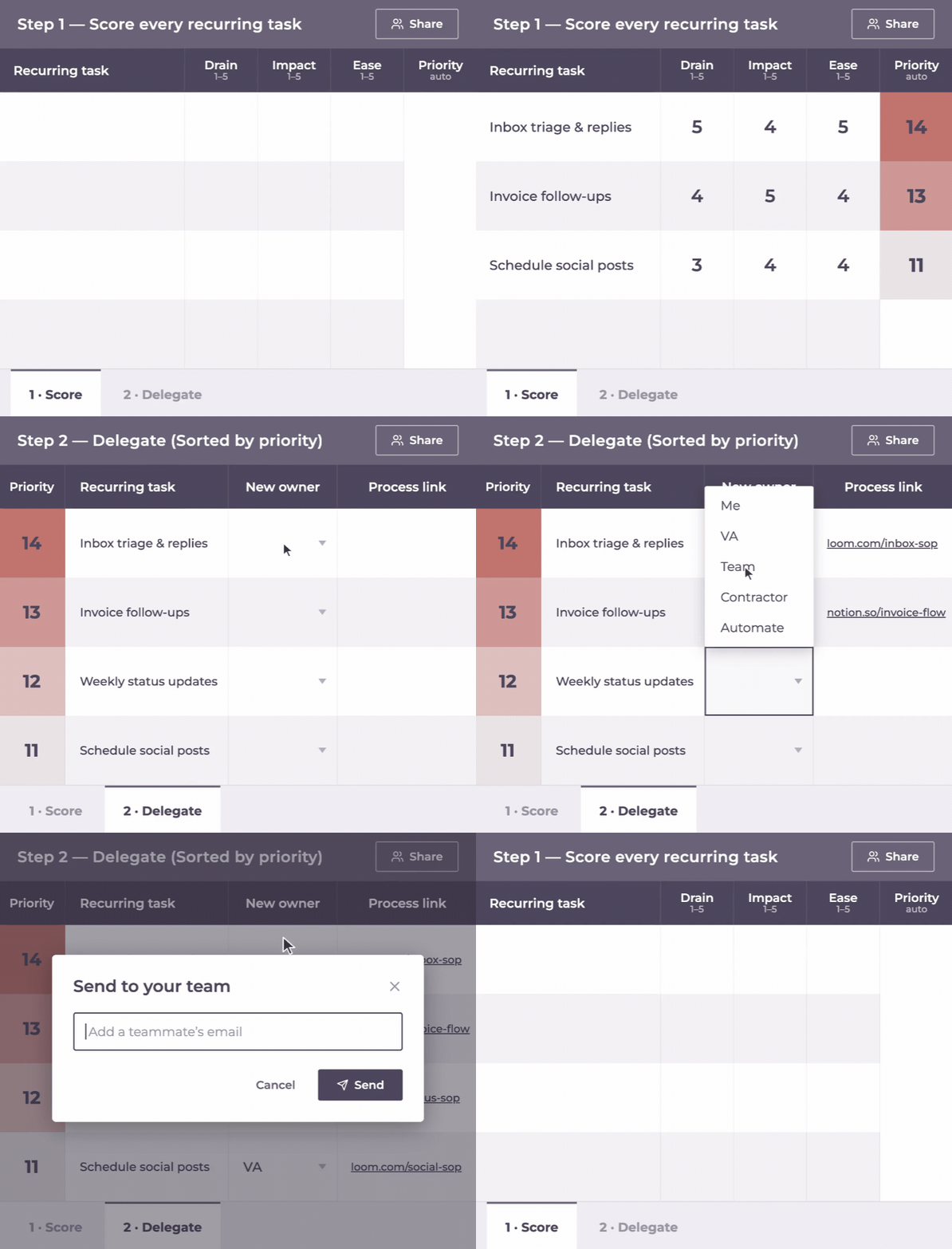
You can grab the free Google Sheets Delegation System here: it’s the framework above, ready to fill in.
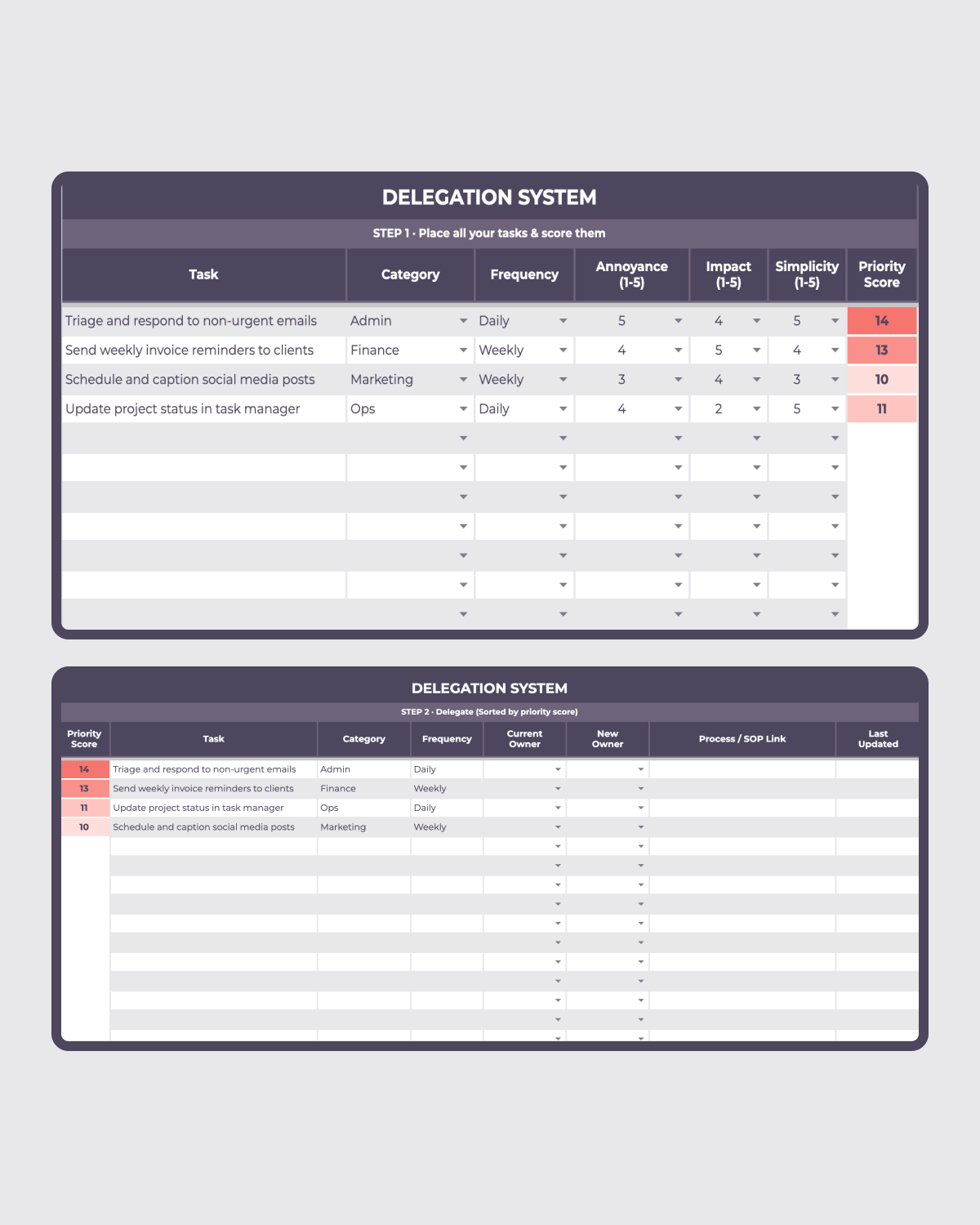
Check out the Free · Delegation System
More infoApplying the framework with no team (yet)
You don’t need employees to use this. If it’s just you, the framework still tells you which tasks to hand to a freelancer, a virtual assistant, or a contractor, starting with your top drains. Begin with just 5–10 hours a week of delegated work. One person handling your inbox, scheduling, and bookkeeping can give you back the mental space to do the work only you can do.
Common framework mistakes to avoid
- Delegating tasks you’ve never documented. If it’s not written down, you’re not delegating; you’re hoping.
- Starting with your most important task. Start with low-stakes wins to build trust on both sides.
- Confusing “busy” with “high impact.” Urgent and important aren’t the same thing; the framework forces you to tell them apart.
- Micromanaging after the hand-off. If you review every step, you’ve kept the task; you’ve just added a person to it.
A delegation framework isn’t about offloading everything. It’s about building a repeatable way to protect your time, so your business stops depending on you for every small thing and finally has room to grow.
Keep reading: How to Decide What to Delegate First and What Tasks Should You Delegate First?.
If you’re ready to build this into how you work, send me an email to try out a coaching session, or start with the free Delegation System and run your first task through the framework this week.




About the Author

Paloma Chiara
Certified Life Coach
Guiding you toward your best self through mindful transformation.
Contact me
The perfect time was last quarter.
Tell me where you're stuck. We'll build the systems around it.
Let's startRecent posts
-
How to Take a Vacation as a Business Owner (Without the Guilt)
Read blog -
How to Overcome the Fear of Raising Your Prices
Read blog -
How to Handle Criticism as a Founder Without Losing Confidence
Read blog -
How to Stop Micromanaging Your Team
Read blog -
The Arrival Fallacy (Why Success Doesn't Feel Like Enough)
Read blog -
Why Business Owners Can't Switch Off From Work
Read blog
Comment