
How to Decide What to Delegate First

Most people don’t actually struggle with how to delegate. They struggle with deciding what to delegate first. When everything on your plate feels important, handing any of it off feels risky, so you keep doing all of it, and the overwhelm never lifts. The fix isn’t working harder at letting go. It’s having a simple way to score your tasks so the decision makes itself.
Why deciding what to delegate is so hard
Delegation advice usually skips the hardest part. “Just hand off the low-value stuff” sounds obvious until you’re staring at a to-do list where everything feels load-bearing. A few things get in the way:
- Everything feels urgent. Without a way to compare tasks, the loudest one wins, not the one that would free you the most.
- You assume explaining it will take longer than doing it. Sometimes true, often not. But “it’s faster if I just do it” is the sentence that keeps you doing everything forever.
- You confuse “only I can do this” with “I’ve always done this.” Most of your recurring work is the second one wearing the costume of the first.
The way out is to stop deciding emotionally and start scoring objectively.
The 3 questions that decide what to delegate
For every recurring task you do, ask three questions and rate each from 1 to 5:
1. How much does it drain you? (Drain)
Not how long it takes, but how much energy and attention it costs. The task you dread at 4pm, the one you procrastinate on, the one that leaves you depleted. A high drain score is a strong signal to hand it off, because the cost isn’t just the minutes: it’s everything you do worse afterward.
2. How much does it actually matter? (Impact)
Does this task move your business or life forward, or does it just keep the lights on? Replying to routine emails keeps things running but rarely matters. Closing a key client or designing your core offer matters enormously. Low-impact tasks are your first delegation candidates.
3. How easy is it to explain to someone else? (Transferability)
If you could write the steps down or record a five-minute walkthrough, it’s transferable. If it lives entirely in your head and changes every time, it’s harder to hand off (for now). High-transferability tasks are the quickest wins.
How to turn three scores into one decision
Here’s the move most people miss: you don’t delegate the task you hate most, or the task that’s easiest. You delegate the task with the best combination. A task that’s high drain, low impact, and easy to explain is the obvious first thing to hand off. A task that’s high impact and only you can do stays with you, no matter how busy you are.
This is exactly what I built the free Delegation System to do for you: it takes those three scores and auto-generates a priority score, so you don’t have to do the math or second-guess yourself.
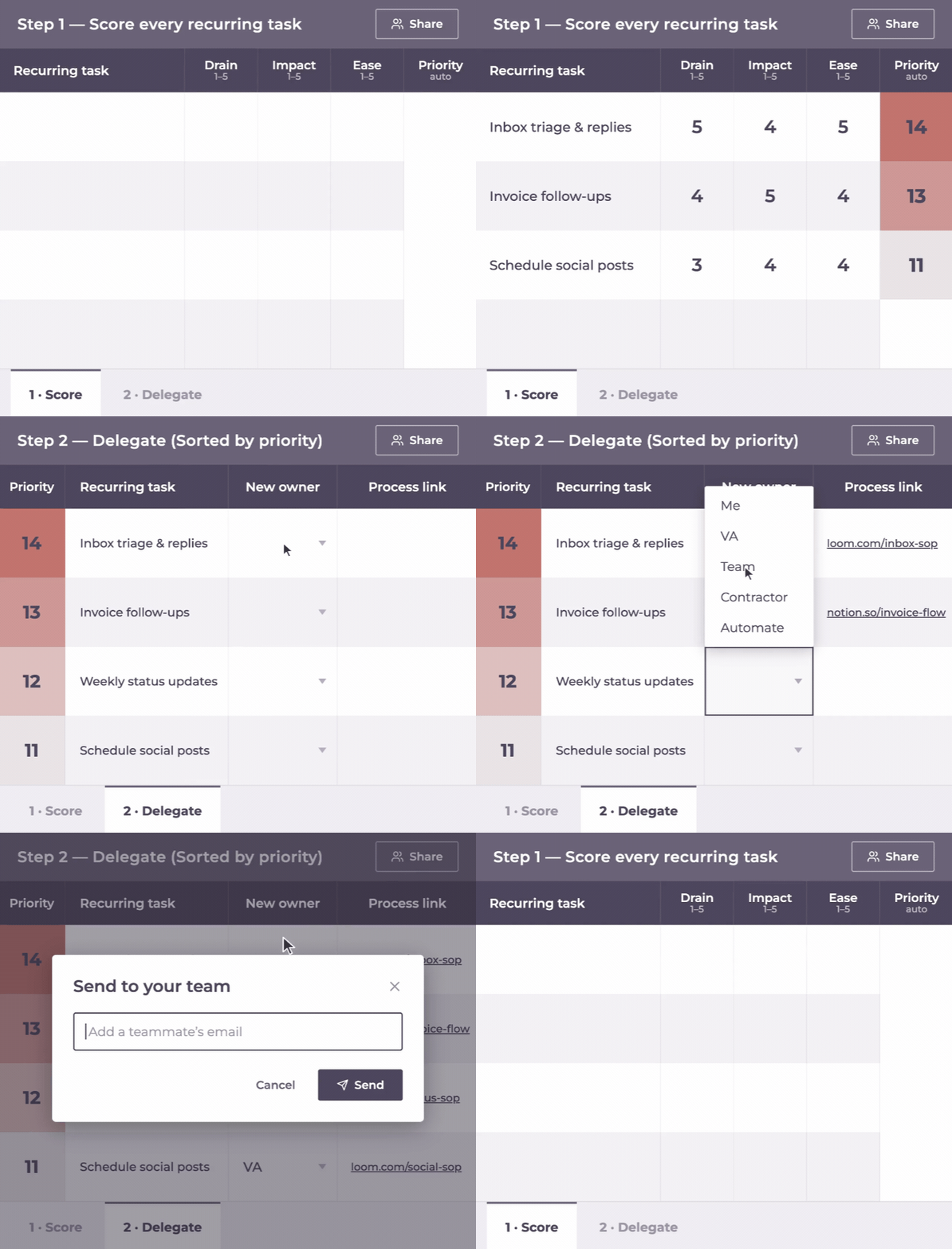
You can grab the free Google Sheets Delegation System here: score each recurring task once, and it ranks exactly what to hand off first, then lets you assign an owner and drop in a process link so it’s ready to send to your team.
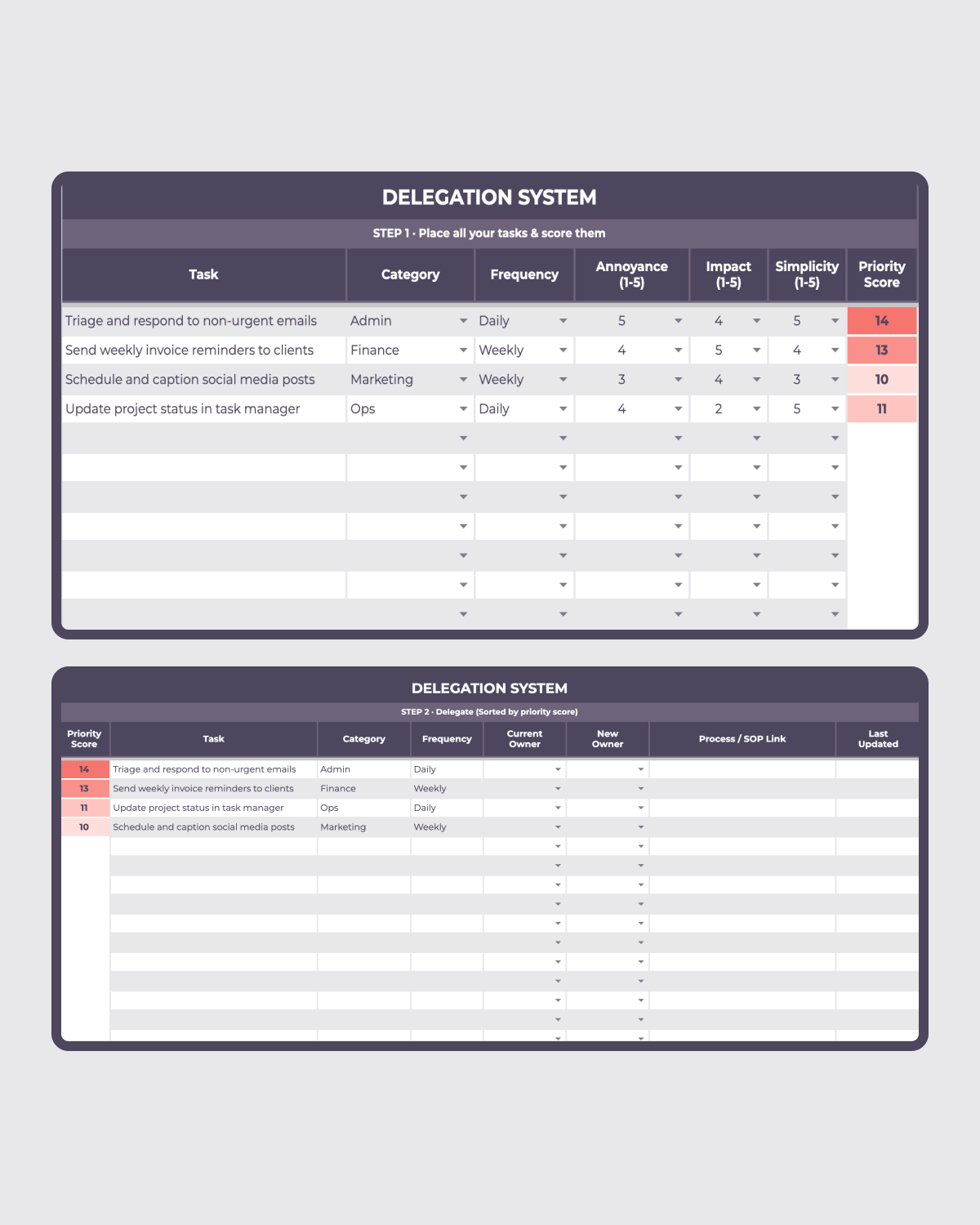
Check out the Free · Delegation System
More infoWhat to delegate first (in order)
When you score honestly, the same categories tend to rise to the top:
- Administrative upkeep (inbox triage, scheduling, data entry, reminders). High drain, low impact, easy to explain. Almost always your first hand-off.
- Repetitive content tasks (formatting, publishing, basic editing, uploading). Predictable and documentable.
- Research and gathering (pulling information, comparing options, first drafts you’ll refine).
- Bookkeeping and reconciliation, important but rarely needs you specifically.
Studies on delegation suggest starting with just 5–10 hours a week, beginning with the tasks that free the most mental load. You don’t need a big team: one freelancer or assistant handling your top three drains can give you a different week.
What you should not delegate
Just as important as knowing what to hand off is knowing what to protect:
- Your core genius (the work only you can do well, that clients pay you for).
- Key relationships (high-stakes conversations and decisions).
- Vision and direction (where you’re going and why).
If a task scores high impact and low transferability, keep it. Delegation isn’t about offloading everything; it’s about protecting the few things that actually require you.
A simple way to start this week
- List every recurring task you did this week, and be specific.
- Score each one on drain, impact, and transferability (1–5).
- Sort by priority and pick your top one or two to hand off.
- Write the process down once (a short doc or screen recording).
- Assign it to a person and let go, checking the outcome, not every step.
The goal of the first round isn’t to delegate everything. It’s to prove to yourself that the world keeps turning when you let one thing go. That single experience is usually what unlocks the rest.
Keep reading: What Tasks Should You Delegate First? and A Delegation Framework for Small Business Owners.
If you’re ready to stop doing everything yourself, send me an email to try out a coaching session, or start with the free Delegation System and see what you can hand off this week.




About the Author

Paloma Chiara
Certified Life Coach
Guiding you toward your best self through mindful transformation.
Contact me
The perfect time was last quarter.
Tell me where you're stuck. We'll build the systems around it.
Let's startRecent posts
-
How to Take a Vacation as a Business Owner (Without the Guilt)
Read blog -
How to Overcome the Fear of Raising Your Prices
Read blog -
How to Handle Criticism as a Founder Without Losing Confidence
Read blog -
How to Stop Micromanaging Your Team
Read blog -
The Arrival Fallacy (Why Success Doesn't Feel Like Enough)
Read blog -
Why Business Owners Can't Switch Off From Work
Read blog
Comment