
How Can a Life Coach Help with Financial Anxiety?
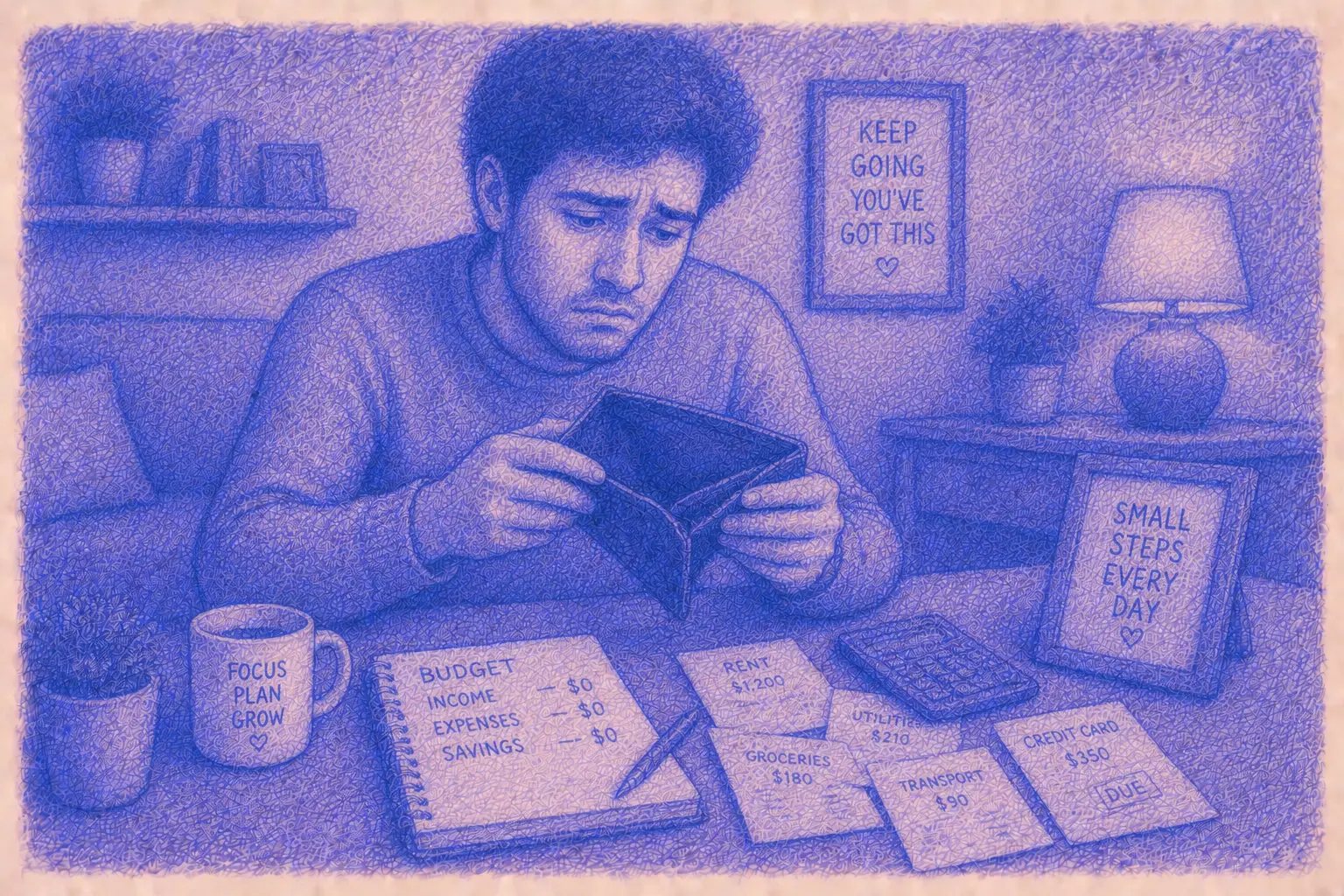
Financial anxiety rarely tracks your bank balance. I’ve worked with founders sitting on two years of runway who still check their accounts six times a day, and freelancers with almost nothing saved who sleep fine.
What drives the anxiety is the story you tell yourself about the number.
A financial advisor works on the spreadsheet. A life coach works on the person reading it, including the 3 a.m. what-ifs. If money stress is running your decisions right now, here’s what that work looks like.
What Financial Anxiety Actually Looks Like
It doesn’t always look like panic. For a lot of business owners and senior professionals, it’s quieter than that.
You put off opening invoices. You don’t raise your rates because the conversation feels dangerous. You say yes to a client you can’t stand because turning down money feels reckless.
Other signs I see constantly:
- Overworking “just in case,” even when the business is stable
- Avoiding your accounts entirely, then panicking at tax time
- Feeling guilty every time you spend on yourself
- Comparing your income to people who are years ahead of you
If a few of these sound familiar, your nervous system has probably filed money under “danger” and it’s reacting accordingly. That’s a pattern, and patterns can change. Psychology Today’s overview of anxiety is a good primer on why the body treats future threats like present ones.
Finding the Root Cause First
Most money anxiety traces back to something older than your current finances. A parent who fought about bills. A business that failed. A stretch where you genuinely didn’t know how you’d pay rent.
A coach’s job is to ask the questions that get you to that root. The useful one is rarely “how much do you need to save?” It’s “what do you think will happen if you don’t?”
The answer is usually revealing. “I’ll be a failure.” “Everyone will see I was never good enough.” “I’ll end up like my dad.”
Those are identity fears wearing a financial costume. Once you can name the actual fear, you stop fighting a vague dread and start working on something specific. That’s when budgets and plans begin to stick.
Setting Financial Goals You’ll Actually Hit
Anxious people tend to set money goals in one of two ways: impossibly big (“I need €100k saved by December”) or not at all, because looking at the gap hurts too much.
Both keep the anxiety alive. The big goal guarantees you’ll feel behind. No goal means you never get proof you’re making progress.
In coaching, we break the goal down until the next step is almost boring. Open the account. Set up the transfer. Move €200 on payday. Review the numbers every Friday for 15 minutes.
Progress you can see is the fastest way to calm a brain that’s convinced everything is falling apart. I wrote about goal-setting theory and why specific targets beat vague ones, if you want the research behind it.

Check out the Free · Vision to Action Planner
More infoShifting Your Beliefs About Money
Some beliefs get installed so early you don’t notice them. “Money is hard to make.” “If I charge more, people will think I’m arrogant.” “I’ll never have enough.”
These scripts run in the background and shape every decision. They’re why you discount your services without being asked, or freeze when an opportunity needs an upfront investment.
A coach helps you catch those beliefs in the act, question whether they’re true, and swap them for something more accurate. Here’s a list of 50 of the most common limiting beliefs, and several of them are about money.
You don’t need to believe you’ll be a millionaire. You just need to stop believing that one bad month means you’re finished.
Building Money Habits That Lower the Noise
Habits do the heavy lifting once the mindset shifts. The ones that calm financial anxiety are usually simple:
- A weekly money review at a fixed time, so your brain stops scanning for threats all week
- Automatic transfers to savings and tax accounts the day income lands
- One dashboard (a spreadsheet works) so you know your real numbers instead of guessing
- A small “buffer” account you’re allowed to dip into without guilt
The weekly review matters most. When you know you’ll look at everything on Friday at 4 p.m., you give yourself permission not to think about it on Tuesday at midnight.



Building Resilience for the Bad Months
Every business has a bad month. Every career has a surprise: a client who doesn’t pay, or a tax bill twice what you expected.
Those things will happen. What financial anxiety decides is how long they knock you over.
Part of coaching is building a plan for those moments before they arrive. What’s your minimum monthly number? Who do you call first? What will you do in the first 48 hours? When you’ve already answered those questions calmly, a setback becomes a problem to solve instead of proof that everything’s collapsing.
Writing helps too. Put down the worst-case scenario, then the most likely one. It takes a spiraling thought and gives it edges, and most of the time the likely outcome is annoying, nowhere near catastrophic.
I know this one personally. I went self-employed at 21, after moving to Spain with a design and literature degree and six months to become financially independent. No plan, no safety net. What got me through was looking at the numbers every single week, especially when I wanted to avoid them.
Accountability Makes the Difference
Money is still one of the hardest things to talk about. Plenty of people will tell you about their health problems before they’ll tell you what they earn or what they owe.
That silence keeps the anxiety going. When nobody sees your finances, every worry stays inside your own head, where it grows.
A coach gives you a space to say the numbers out loud without judgment. Then they hold you to what you said you’d do. Did you send the invoice? Did you have the pricing conversation?
Knowing someone will ask is often enough to get you to do the thing you’ve been avoiding. If avoidance is the bigger pattern for you, my piece on procrastination goes into why we put off the tasks that matter most.
Making Money Decisions Without Freezing
Anxious people either decide too fast (to make the discomfort stop) or not at all (because every option feels risky). Neither one serves you.
A big part of the problem is volume. Business owners make hundreds of small decisions a day, and money decisions tend to land at the end of it, when you’re already drained. The New York Times piece on decision fatigue explains why judgment slides as the day goes on.
So we build rules. “Any purchase over €500 waits 48 hours.” “Pricing decisions happen on Monday mornings, never right after a hard client call.”
Rules take the emotion out of the moment. You’ve already decided how you’ll decide, which means less fear and fewer regrets.
When to Bring in Other Support
Coaching works on mindset and habits. For technical advice on tax or debt, you still want an accountant or a financial advisor.
And if the anxiety has spilled into your sleep or your health, speak to a therapist or doctor as well. I wrote more about where that line sits in can a life coach help with anxiety.
The best results usually come from combining them. The advisor builds the plan, and the coach makes sure you can actually follow it.
Quiz: What Is Blocking Your Success?
This quick quiz will help you figure out which mental or behavioral pattern might be holding you back from achieving your full potential. Identifying your specific success blocker is the first step toward breaking through to new levels of achievement and fulfillment.
Read each question and choose the answer that feels most true to your situation.
No email or payment is required to complete the quiz and receive your personalized insights.
Once you have your primary success blocker, you have clarity about what’s been holding you back. This awareness is powerful—many people spend years struggling without understanding the specific pattern that’s limiting their progress.
Remember, these patterns aren’t permanent character traits but rather habitual ways of thinking and behaving that can be changed with the right guidance and practice.
If you’re ready to break through your specific blocker and achieve the success you know you’re capable of, send me an email to try out a coaching session. Your breakthrough awaits!
About the Author

Paloma Chiara
Certified Life Coach
Guiding you toward your best self through mindful transformation.
Contact me
The perfect time was last quarter.
Tell me where you're stuck. We'll build the systems around it.
Let's startRecent posts
-
How to Overcome the Fear of Raising Your Prices
Read blog -
How to Handle Criticism as a Founder Without Losing Confidence
Read blog -
How to Stop Micromanaging Your Team
Read blog -
The Arrival Fallacy (Why Success Doesn't Feel Like Enough)
Read blog -
Why Business Owners Can't Switch Off From Work
Read blog -
How to Set Boundaries with Your Team Without Feeling Like a Bad Boss
Read blog
Comment