
What Is Goal-Setting Theory?

Goal-setting theory is Edwin Locke’s explanation for why some people consistently hit their goals and others don’t. He published the original research in 1968. Over 50 years of follow-up studies later, the framework still holds up — because it’s based on how motivation actually works, not how we wish it did.
The core finding: specific, difficult goals lead to higher performance than vague or easy ones. Almost every time.
The 5 principles
Locke and psychologist Gary Latham refined the theory together over decades. By 1990, they’d published the work that still shapes how coaches, managers, and psychologists think about goal pursuit today. They landed on 5 factors that determine whether a goal actually drives behavior.
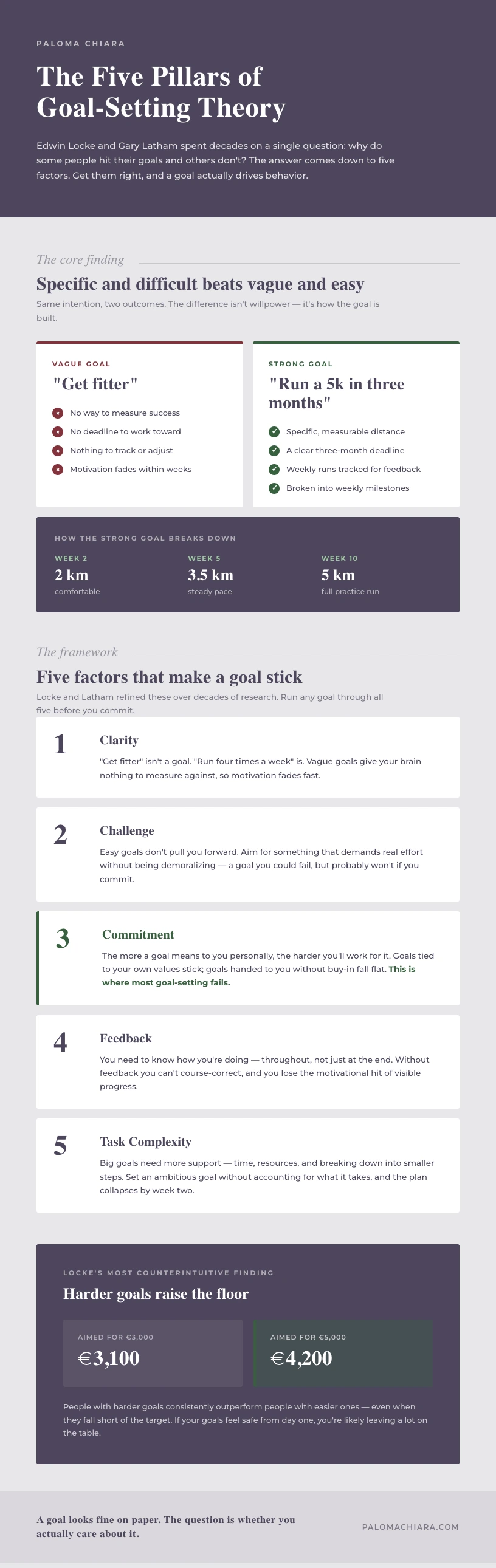
Clarity. “Get fitter” isn’t a goal. “Run 4 times a week” is. Vague goals give your brain nothing to work with — there’s no way to know if you’ve succeeded, so motivation fades fast.
Challenge. Easy goals don’t pull you forward. You need something that requires real effort, without being so hard it becomes demoralizing. The sweet spot is a goal you could fail — but probably won’t if you commit.
Commitment. The more the goal means to you personally, the harder you’ll work for it. Goals assigned by someone else with no buy-in tend to fall flat. Goals tied to your own values don’t.
Feedback. You need to know how you’re doing — not just at the end, but throughout. Without feedback, you can’t course-correct, and you lose the motivational hit of seeing progress.
Task complexity. Big goals need more support: time, resources, and usually some breaking down into smaller steps. Setting an ambitious goal without accounting for what it actually takes is how plans fall apart in week 2.
Check out the Free · Vision to Action Planner
More infoWhat this looks like in practice
The theory only gets useful when you apply it to something real.
Running a 5k in 3 months. Specific and measurable (not “get in better shape”). Challenging for someone starting from scratch, but doable. You track weekly runs to see progress and adjust training if you’re falling behind. Break it down: 2k comfortable by week 2, 3.5k by week 5, a full practice run by week 10.
Getting promoted within a year. Trickier, because you don’t fully control the outcome. Locke’s framework helps here: define what’s actually in your control (taking on new projects, building specific skills, improving visibility) and treat those as the real goals. The promotion is the result. Career goals like this work best when you focus on process, not just outcome.
Saving €5,000 in 6 months. Saving €833 a month is clear and measurable. Monthly check-ins create the feedback loop. And if you’re falling short, you can respond — cut subscriptions, pick up freelance work, adjust the timeline. That flexibility is the point.
Where goal-setting theory breaks down
Worth knowing: this framework doesn’t work as well for tasks requiring creativity or open-ended problem-solving. When goals are too narrow, they can cause tunnel vision — you hit the metric and miss the actual point.
Also: commitment matters more than most people factor in. You can have a perfectly clear, challenging goal and still abandon it if it doesn’t connect to something you actually care about. That’s where your personal development plan matters — goals don’t exist in isolation.
And if you consistently set goals and don’t follow through, the issue usually isn’t the goal itself. It’s the habit loop underneath, or procrastination dressed up as planning.
A note on difficulty
One of Locke’s most counterintuitive findings: people with harder goals consistently outperform people with easier ones — even when the harder-goal group doesn’t fully hit their targets.
Meaning: shooting for €5,000 and landing at €4,200 often beats shooting for €3,000 and hitting €3,100. The higher aspiration raises the floor.
If you’ve been setting “realistic” goals that feel safe from day 1, you’re probably leaving a lot on the table. Forbes research on high performers consistently shows the same thing: the people who hit ambitious targets started by believing the target was worth setting.


Putting it together
The theory gives you a checklist, but the real skill is honest self-assessment. Ask yourself: is this goal actually specific? Is it hard enough to require real effort? Do I actually care about it, or did I set it because it seemed like the right thing to want?
Most goal-setting fails at commitment. The goal looks fine on paper, but there’s no emotional stake in it. That’s the part no framework can do for you — it has to come from your own values and priorities.
Quiz: What Is Blocking Your Success?
This quick quiz will help you figure out which mental or behavioral pattern might be holding you back from achieving your full potential. Identifying your specific success blocker is the first step toward breaking through to new levels of achievement and fulfillment.
Read each question and choose the answer that feels most true to your situation.
No email or payment is required to complete the quiz and receive your personalized insights.
Once you have your primary success blocker, you have clarity about what’s been holding you back. This awareness is powerful—many people spend years struggling without understanding the specific pattern that’s limiting their progress.
Remember, these patterns aren’t permanent character traits but rather habitual ways of thinking and behaving that can be changed with the right guidance and practice.
If you’re ready to break through your specific blocker and achieve the success you know you’re capable of, send me an email to try out a coaching session. Your breakthrough awaits!
About the Author

Paloma Chiara
Certified Life Coach
Guiding you toward your best self through mindful transformation.
Contact me
The perfect time was last quarter.
Tell me where you're stuck. We'll build the systems around it.
Let's startRecent posts
-
How to Take a Vacation as a Business Owner (Without the Guilt)
Read blog -
How to Overcome the Fear of Raising Your Prices
Read blog -
How to Handle Criticism as a Founder Without Losing Confidence
Read blog -
How to Stop Micromanaging Your Team
Read blog -
The Arrival Fallacy (Why Success Doesn't Feel Like Enough)
Read blog -
Why Business Owners Can't Switch Off From Work
Read blog
Comment