
How to Stop Being the Bottleneck in Your Business

Your business can’t grow past you. If every decision, approval, and fire has to pass through your inbox first, your company’s ceiling is your personal bandwidth. Your market can be wide open and your team genuinely talented, and growth still stalls at the size of your own attention.
I hear a version of this from almost every founder I work with. They didn’t build a business, they built a job that happens to have other people in it, all of them waiting on a “yes” from someone who’s already stretched thin.



How to Know You’ve Become the Bottleneck
Ask what would happen if you disappeared for two weeks with no phone. If the honest answer is “everything stalls,” you’re it.
The signs are usually small and constant, not dramatic. People wait for your reply before starting. Meetings get scheduled around your calendar first, everyone else’s second. You’re cc’d on things that don’t need you, because someone learned the hard way that skipping you causes problems later. Your team has started saying “let me check with [you]” as a reflex, not a real need.
None of this makes you a bad leader. It usually means you were the most capable person in the room for a long time, and the business built its habits around that fact. The habits just never updated. If you want a fuller checklist, I’ve laid out the specific signs you need to delegate before burnout forces the issue.
The Real Reason You’re Still in the Middle of Everything
It’s rarely a time-management problem. Most people who are the bottleneck know exactly how to build a process. They just don’t trust it yet.
Handing off a decision means someone else might make it differently than you would. For a lot of founders, “differently” quietly translates to “worse,” even when there’s no evidence for that. Harvard Business Review has documented this exact pattern in founders: the tactical instincts that got a company off the ground are often the same instincts that quietly cap its growth once the company outgrows one person’s attention.
I see this pattern constantly in my coaching work: smart, capable people who refuse to delegate because letting go of control feels like risk, not relief. The fear isn’t really about the task. It’s about what it means if someone else can do your job. I’ve written before about why letting go of control is so hard to do, and the short version is: it’s rarely about trust in other people. It’s about trust in your own value once you’re not the one doing everything.
Fix the Decisions Before You Fix the Tasks
Most advice on this topic starts with task lists: write down everything you do, hand off the boring parts. That helps, but it treats the symptom. The real fix starts one level up, with decisions.
Sort the decisions that currently land on your desk into three piles:
- Only you. Core strategy, key hires, anything that shapes where the business is headed for years, not weeks.
- You set the rule, someone else applies it. Refund thresholds, hiring criteria, content approval, most client-facing calls. These don’t need your judgment each time, they need your judgment once, written down.
- Never should have reached you. Scheduling, routine replies, anything with an obvious right answer that got escalated out of habit.
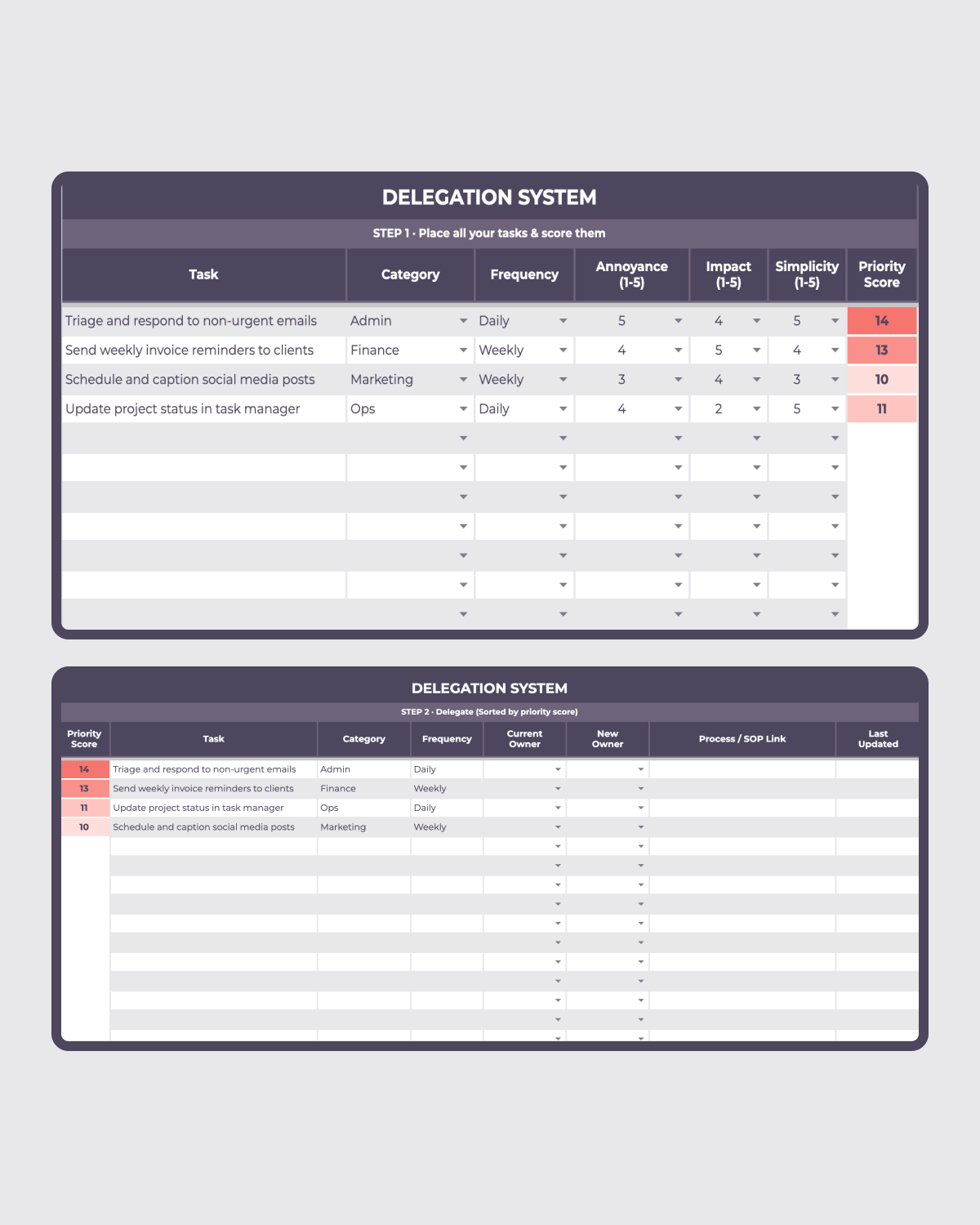
Check out the Free · Delegation System
More infoWrite the rule for the middle pile once, clearly enough that someone else can apply it without asking. That single move removes most of the daily interruptions, because it wasn’t the task creating the bottleneck, it was the missing rule.
Build the System That Holds When You Step Back
A decision rule only works if someone owns applying it. This is where a lot of delegation quietly fails: the task gets handed off, but the ownership doesn’t.
Handing off a task means someone does the steps you tell them. Handing off ownership means they own the outcome, make the calls within it, and come to you with results instead of questions. That distinction is everything. When someone actually owns a piece of the business, they treat it seriously in a way that task-following never produces.
That’s what changed it for me. I didn’t get better at delegating by loosening my standards. I got better by finding people I could actually trust, staying open to being wrong about how something should be done, and testing their ideas instead of overruling them by default. Once someone owns a thing, they take it seriously.
Give it a real structure: a clear owner, a documented process (even a five-minute screen recording beats nothing), and one scheduled check-in instead of ten ad hoc ones. My step-by-step delegation framework walks through this in more detail, and if you want a starting point for deciding what to hand off first, I also built a free Delegation System that scores tasks by how much they drain you, how much they matter, and how easy they are to explain.
What Changes Once You’re Not the Bottleneck
The real win is that decisions start getting made closer to where the information actually is, by people who don’t have to wait in a queue behind everyone else’s questions. You end up doing less, but that’s a side effect, not the point.
You also get something you didn’t budget for: the mental space to actually think. The New York Times has covered how decision-making itself depletes the mental energy needed to decide well, and every decision routed through you unnecessarily is spending down a limited resource on something that didn’t need you at all.
If your business still can’t move without you and you want a clear plan built on real systems, reach out for a coaching session. We’ll map exactly what’s still routing through you and build the structure to route it elsewhere.
Quiz: what’s blocking your success?
This quick quiz will help you uncover which mental or behavioural pattern might be holding you back from reaching your full potential. Identifying your specific blocker is the first step to overcoming it.
Read each question and choose the answer that best fits your situation.
No email or payment required to complete the quiz and receive your personalised results.
Once you know your main blocker, you’ll have clarity on what’s been holding you back. These patterns are not permanent traits, they are habitual ways of thinking and acting that can be changed with the right guidance and practice.
If you’re ready to overcome your specific blocker, email me to try a coaching session.
About the Author

Paloma Chiara
Certified Life Coach
Guiding you toward your best self through mindful transformation.
Contact me
The perfect time was last quarter.
Tell me where you're stuck. We'll build the systems around it.
Let's startRecent posts
-
How to Overcome the Fear of Raising Your Prices
Read blog -
How to Handle Criticism as a Founder Without Losing Confidence
Read blog -
How to Stop Micromanaging Your Team
Read blog -
The Arrival Fallacy (Why Success Doesn't Feel Like Enough)
Read blog -
Why Business Owners Can't Switch Off From Work
Read blog -
How to Set Boundaries with Your Team Without Feeling Like a Bad Boss
Read blog
Comment