
Why You Can't Let Go of Control in Your Business

You know you should delegate. You’re exhausted, your to-do list never empties, and you keep telling yourself you’ll hand things off “once things calm down.” But the moment it comes to actually letting go, something stops you. If you can’t let go of control even when you’re drowning, it’s almost never a time problem. It’s a trust problem: with others, and quietly, with yourself.
Why letting go feels impossible
The inability to delegate usually isn’t about being disorganized or not having anyone to hand things to. It’s emotional, and naming the real reason is the first step to loosening its grip.
“Nobody will do it as well as I will”
This is the most common one, and it’s half true: at first, someone else won’t do it exactly the way you would. But “exactly the way I would” and “well enough” are different standards, and holding everything to the first one guarantees you’ll do everything forever. Perfectionism dressed up as high standards is one of the biggest drivers of overwhelm.
“If I’m not the one doing it, who am I?”
For a lot of high achievers, being the person who does it all is the identity. Your competence is how you’ve earned recognition your whole life. Handing work off can feel like handing off a piece of yourself, or losing the validation that comes from being indispensable. That fear is real, and it keeps you stuck in the cycle.
“I can’t trust that it’ll be okay”
Control often is a symptom of burnout, not just a cause. When you’re depleted, your nervous system doesn’t want surprises, so it clamps down on everything it can. The tighter you hold, the more drained you get, and the more drained you get, the tighter you hold.
“It’s faster if I just do it myself”
True today, expensive forever. Every task you refuse to teach is a task you’ve guaranteed will always need you. The hour you “save” by not explaining it is an hour you’ll spend again next week, and the week after that.
The hidden cost of holding on
Refusing to let go feels responsible, but it quietly costs you the things you actually want. You stay buried in low-value work, so the high-value work (the vision, the strategy, the relationships) never gets your best energy. You become the bottleneck your business can’t grow past. And the exhaustion compounds, because you’re not just tired from the work; you’re tired from the vigilance of overseeing everything.
Letting go isn’t the reckless option. Staying in control of everything is.
The reframe: from control to trust, with a safety net
Here’s the shift that actually works: you don’t have to choose between white-knuckle control and blind, reckless letting go. The reason delegation feels reckless is that it feels vague: you’re handing off something important with no structure. Take away the vagueness and most of the fear goes with it.
That means getting concrete about three things for any task you’re clinging to: how much it’s actually draining you, how much it genuinely matters, and how easy it would be to explain to someone else. When you can see those answers in black and white, “I can’t let this go” usually turns into “oh, I’ve been holding onto this for no good reason.”
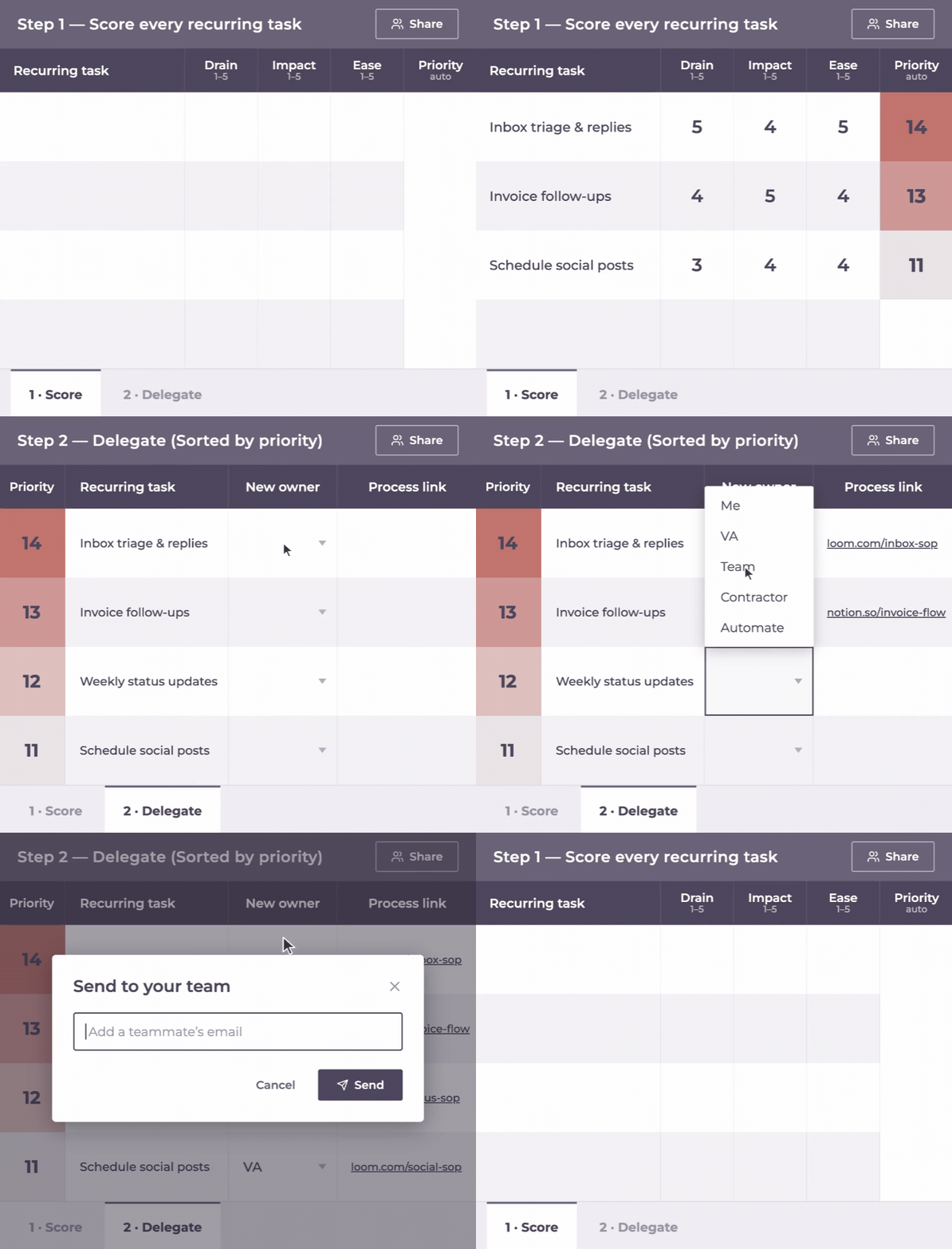
I built a free Delegation System in Google Sheets to make exactly this concrete. You score each task on drain, importance, and how easy it is to explain, and it ranks what to let go of first. Then you assign an owner and add a process link so handing it off feels safe instead of scary. You can get the free Delegation System here.
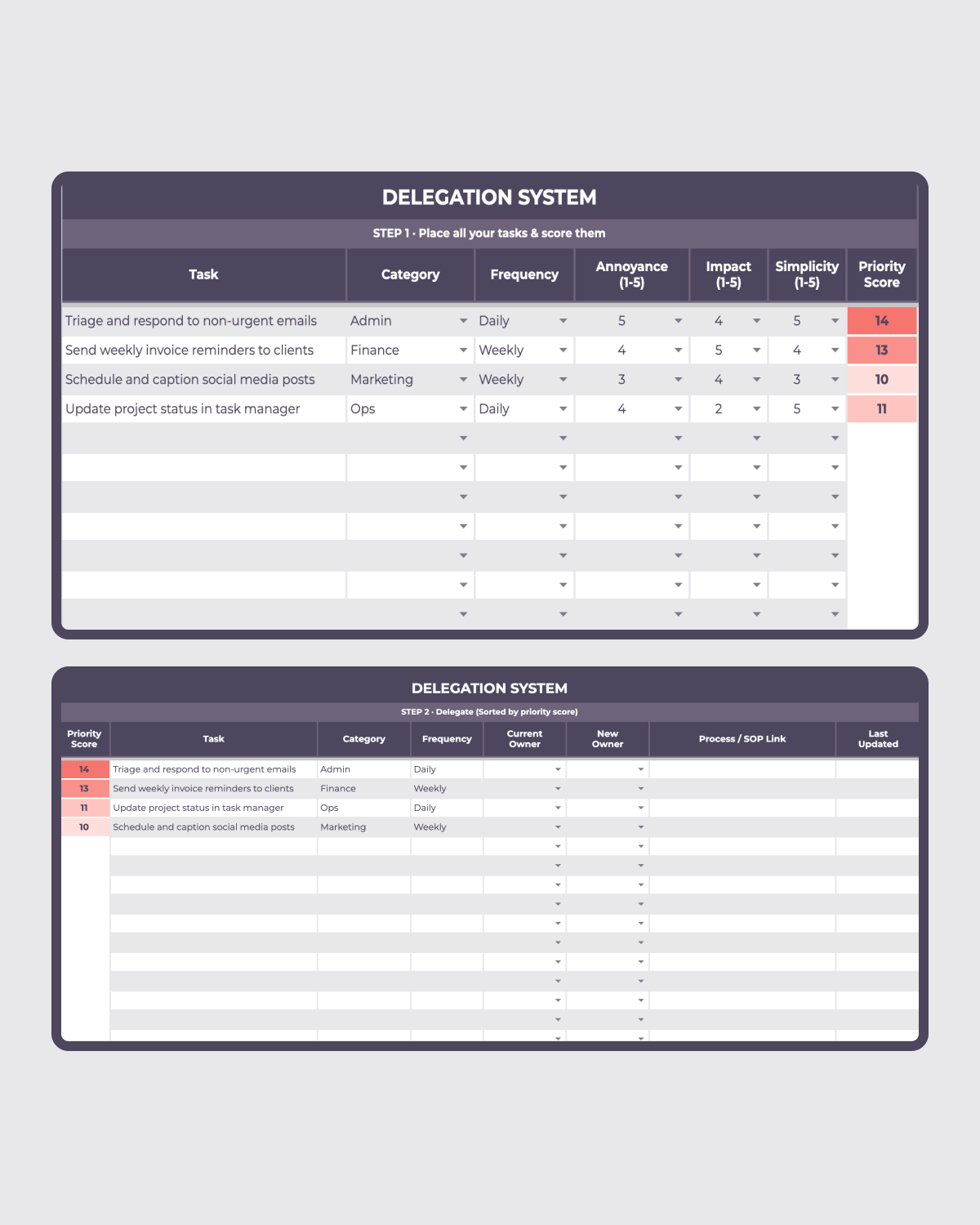
Check out the Free · Delegation System
More infoHow to start letting go (without it feeling reckless)
You don’t rebuild trust by leaping. You build it in small, contained experiments.
- Start with one low-stakes task. Pick something that, if it goes a little wrong, costs you almost nothing. The point is the experience, not the efficiency.
- Define “good enough” in advance. Write down what a successful outcome looks like so you’re judging the result, not the method.
- Hand off the outcome, not your way of doing it. Let the person reach the goal their own way. Their path won’t be yours, and that’s fine.
- Check the result, not every step. Resist the urge to hover. One review point, not ten.
- Notice that it was okay. This is the part that rewires the fear. Each time the world keeps turning, letting go of the next thing gets easier.
You’re allowed to not do it all
Somewhere along the way, you learned that doing everything yourself was the proof of your worth. It isn’t. The most capable people aren’t the ones holding the most; they’re the ones who’ve learned what to hold and what to release. Letting go of control isn’t lowering your standards. It’s finally applying them to the right things.
Keep reading: 7 Signs You Need to Delegate (Before Burnout) and How to Decide What to Delegate First.
If control has been your default, you don’t have to untangle it alone. Send me an email to try out a coaching session, or start with the free Delegation System and prove to yourself, one task at a time, that letting go is safe.



About the Author

Paloma Chiara
Certified Life Coach
Guiding you toward your best self through mindful transformation.
Contact me
The perfect time was last quarter.
Tell me where you're stuck. We'll build the systems around it.
Let's startRecent posts
-
How to Overcome the Fear of Self-Promotion as a Business Owner
Read blog -
How to Take a Vacation as a Business Owner (Without the Guilt)
Read blog -
How to Overcome the Fear of Raising Your Prices
Read blog -
How to Handle Criticism as a Founder Without Losing Confidence
Read blog -
How to Stop Micromanaging Your Team
Read blog -
The Arrival Fallacy (Why Success Doesn't Feel Like Enough)
Read blog
Comment