
How to Recover from Work Burnout
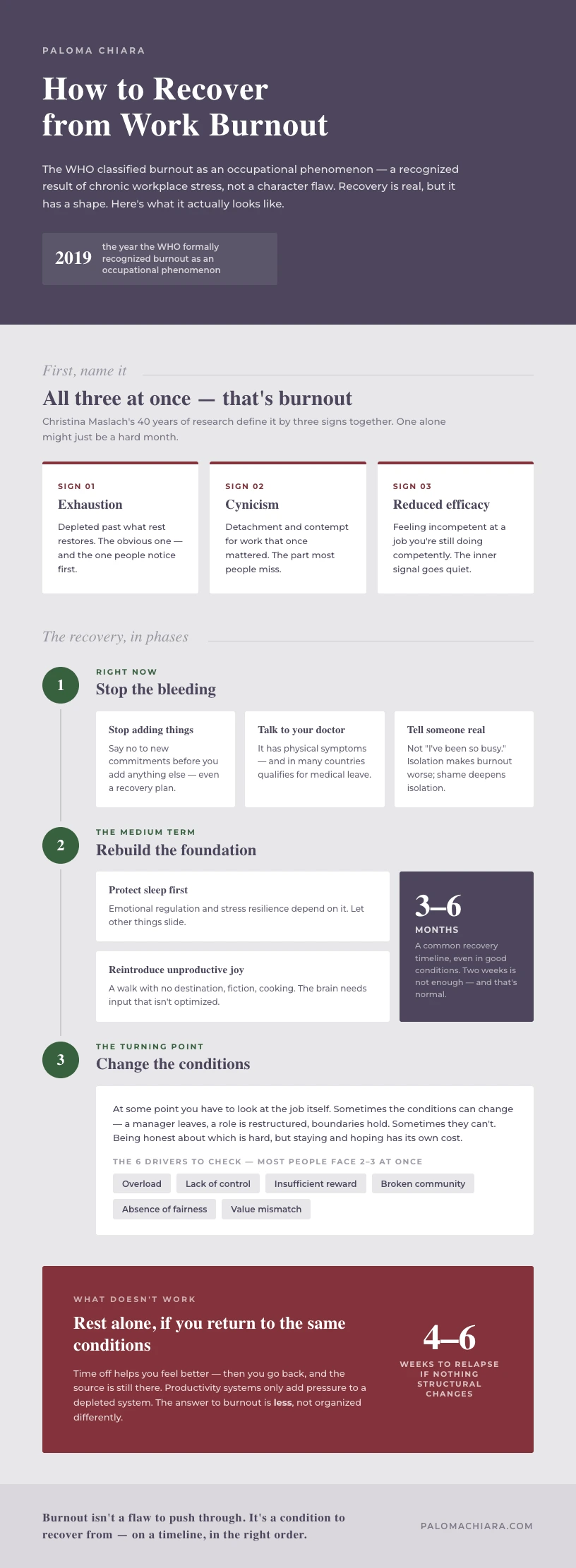
The WHO classified burnout as an occupational phenomenon in 2019. Not a character flaw or a sign you can’t handle pressure. A recognized result of chronic workplace stress that hasn’t been addressed.
That distinction matters, because most people dealing with work burnout spend a significant portion of their recovery blaming themselves for it.



What Work Burnout Actually Is
Burnout has 3 distinct components according to Christina Maslach, whose research has defined the field for 40 years: exhaustion, cynicism, and a reduced sense of efficacy.
Exhaustion is the most obvious one. But cynicism is the part people often miss. When you start feeling detached, contemptuous of the work or the people around you, or unable to care about things that used to matter, that’s burnout talking. And reduced efficacy is when you feel incompetent at a job you’re probably still doing competently. You’ve lost the inner signal that you’re doing okay.
All 3 together. That’s burnout. One of them alone might be a hard month.
How to Know It’s Burnout and Not Just a Bad Stretch
A bad stretch has an end point. You can see it: the project finishes, the quarter turns, the thing resolves. And rest actually helps. A weekend away makes a difference.
Burnout doesn’t work like that. Rest doesn’t touch it, or touches it only briefly before the same dread returns. The end point keeps moving. And the exhaustion bleeds into everything else, not just work hours.
If you’ve taken time off and come back feeling exactly the same, that’s a sign the issue isn’t tiredness. It’s structural.
What Causes It
Maslach identified 6 workplace conditions that drive burnout. Knowing which ones apply to your situation matters, because recovery looks different depending on the source.
Overload. More than you can reasonably do in the hours you have. Chronic, not occasional.
Lack of control. You’re accountable for outcomes you can’t actually influence. Decisions happen above you, without you, and you absorb the consequences.
Insufficient reward. The compensation (financial or otherwise) doesn’t match the output. Or the work goes unrecognized in ways that matter to you.
Breakdown of community. The team is hostile, isolated, or just absent. No one has your back. Trust is low.
Absence of fairness. Workload, recognition, and opportunity are distributed in ways that feel arbitrary or biased.
Value mismatch. What the job requires you to do conflicts with what you actually believe. You spend energy rationalizing rather than working.
Most people in burnout are dealing with 2 or 3 of these at once. Identifying the specific ones helps you figure out whether the situation can be changed or whether it can’t.

Check out the Free · Vision to Action Planner
More infoWhat to Do Right Now
Stop adding things. Before you do anything else, stop saying yes to new commitments. Burnout makes the idea of adding a recovery plan feel like another item on the list. So don’t. Just stop the bleeding first.
Talk to your doctor. Burnout has physical symptoms: disrupted sleep, lowered immunity, headaches, cognitive fog. A doctor can rule out other causes and, if needed, support you in taking proper time off. In many countries, burnout qualifies for medical leave.
Tell someone what’s actually happening. Not a performative “I’ve been so busy lately.” A real conversation with someone you trust about how bad it’s gotten. Isolation makes burnout worse. The shame of it makes isolation worse.
The Medium-Term Recovery
Recovery from serious work burnout takes months, not weeks. Research suggests 3 to 6 months is common even with good conditions. That timeline is uncomfortable but worth knowing, because people often panic when they don’t feel better after 2 weeks and conclude something is permanently wrong with them.
Sleep is the non-negotiable foundation. Cognitive function, emotional regulation, and stress resilience all depend on it. Before you do anything else, prioritize sleep even if that means letting other things slide.
Reintroduce activities that aren’t productive. Not exercise as optimization, not meditation as a performance hack. Things you do for no reason except that they give you something. A walk with no destination. Cooking something you like. Reading fiction. The brain needs input that isn’t instrumentalized.
Slowly, as capacity returns, start asking the harder questions about what needs to change structurally.
What Doesn’t Help
Rest alone is not enough if you return to the same conditions. This is the most common mistake in burnout recovery. You take time off, you feel somewhat better, you go back, and within 4 to 6 weeks you’re exactly where you were. Because the source is still there.
Productivity optimization also doesn’t help. Better systems, more efficient routines, improved time management: all of these put more pressure on a system that’s already depleted. The answer to burnout is less, not organized differently.
The Structural Question
At some point in recovery, you have to look at the job itself. Sometimes the conditions that caused burnout can change: a manager leaves, a role gets restructured, boundaries get established and held. Sometimes they can’t.
Being honest about which situation you’re in is hard, especially when the identity and income tied to the job make leaving feel impossible. But staying in the conditions that caused burnout, hoping they’ll change, is its own kind of cost.
If you’re not sure which category you’re in, that’s worth working through deliberately rather than just hoping.
When to Get Professional Support
If the exhaustion is severe, if you’re experiencing depression or anxiety alongside the burnout, or if you’ve been struggling for more than a few months without improvement, talk to a therapist or psychiatrist. Burnout and clinical depression overlap significantly, and the right kind of support makes a real difference in how long recovery takes.
Coaching is useful at a different stage: when you’re stable enough to think, but you need help figuring out what comes next, what you actually want from your work, and how to build conditions that don’t reproduce the same outcome.
If that’s where you are, reach out.
Quiz: What Is Blocking Your Success?
This quick quiz will help you figure out which mental or behavioral pattern might be holding you back from achieving your full potential. Identifying your specific success blocker is the first step toward breaking through to new levels of achievement and fulfillment.
Read each question and choose the answer that feels most true to your situation.
No email or payment is required to complete the quiz and receive your personalized insights.
Once you have your primary success blocker, you have clarity about what’s been holding you back. These patterns aren’t permanent character traits, they’re habitual ways of thinking and behaving that can be changed with the right guidance and practice.
If you’re ready to break through your specific blocker, send me an email to try out a coaching session.
About the Author

Paloma Chiara
Certified Life Coach
Guiding you toward your best self through mindful transformation.
Contact me
The perfect time was last quarter.
Tell me where you're stuck. We'll build the systems around it.
Let's startRecent posts
-
How to Take a Vacation as a Business Owner (Without the Guilt)
Read blog -
How to Overcome the Fear of Raising Your Prices
Read blog -
How to Handle Criticism as a Founder Without Losing Confidence
Read blog -
How to Stop Micromanaging Your Team
Read blog -
The Arrival Fallacy (Why Success Doesn't Feel Like Enough)
Read blog -
Why Business Owners Can't Switch Off From Work
Read blog
Comment